

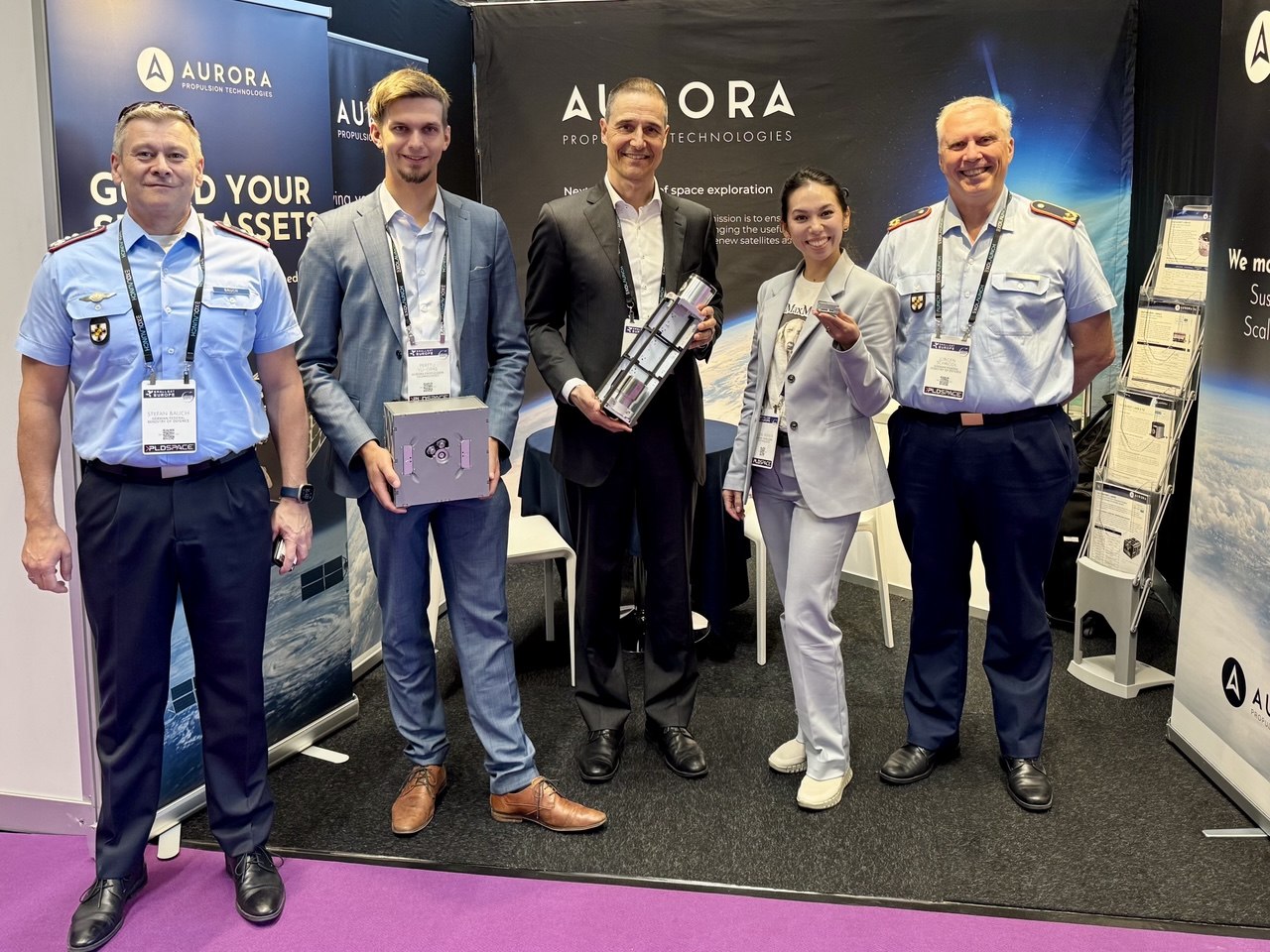

Three days. 21 qualified conversations. One clear signal — propulsion is no longer a late-stage line item, but a day-one design decision for commercial and defence operators alike.
Espoo / Amsterdam — Aurora Propulsion Technologies closed three days at SmallSat Europe in Amsterdam with a single, consistent takeaway from the people who visited our booth: they didn’t arrive curious. They arrived with requirements.
A market converging on the same requirement
A few years ago, propulsion was specified late in the mission. Today it is one of the first conversations. The five-year deorbit rule introduced by ESA and the FCC has moved disposal from an end-of-life afterthought to a launch-day design decision — and once a mission is designed for clean disposal, it is also designed for maneuverability, redundancy and safety from the outset.
Two trends were visible on the show floor, pulling in opposite directions. Commercial satellites are getting bigger. Defence satellites are getting smaller. Yet both converge on the same need: propulsion that is compact, safe and dependable, with the hard constraints — geometry, total impulse, thrust, redundancy and explosion risk — engineered in from day one.
From claims to flight data
A defining moment came when Aurora CTO Perttu Yli-Opas presented flight data from the WISDOM mission, Aurora’s first full propulsion-system flight. For satellite manufacturers, there is a meaningful difference between hearing that a water-based propulsion system performs in orbit and seeing the telemetry that proves it.
“Operators no longer want a promise — they want flight data. Showing real performance from orbit is what turns a technical specification into a procurement decision.” — Aziza Ibrayeva, Chief Commercial Officer, Aurora Propulsion Technologies
The defence shift toward small, survivable assets
Some of the most substantive discussions involved the defence sector’s move toward smaller, more numerous tactical satellites — and the harder question that comes with it: how do you keep high-value orbital assets survivable without generating debris? Aurora held encouraging conversations with defence stakeholders, including allied ministry-of-defence representatives, around clean, non-destructive approaches to protecting critical orbital infrastructure.
Building for higher thrust and faster maneuver
This is why Aurora is engineering its next generation of systems for higher thrust. More thrust means spacecraft that move faster and maneuver harder — whether avoiding a conjunction, repositioning for a new mission, or maintaining proximity to an asset that needs protecting. The next-generation ARM-O module in development targets more than six times the thrust of today’s unit, up to 20 mN, in the same envelope and mass, with first deliveries planned for 2027.
The signal from Amsterdam was clear: sustainability is no longer a compliance checkbox. For serious operators it is a design philosophy and a competitive advantage — and the gap between commercial and defence propulsion requirements is closing fast.
Next stop: India Space Congress, New Delhi
Aurora’s leadership team heads next to the India Space Congress in New Delhi (15–17 June), where a space economy on track to reach $44B by 2033 is having many of the same conversations. If you are a satellite manufacturer, mission integrator or strategic partner who treats propulsion as a strategic choice rather than a checkbox, we would like to meet.