

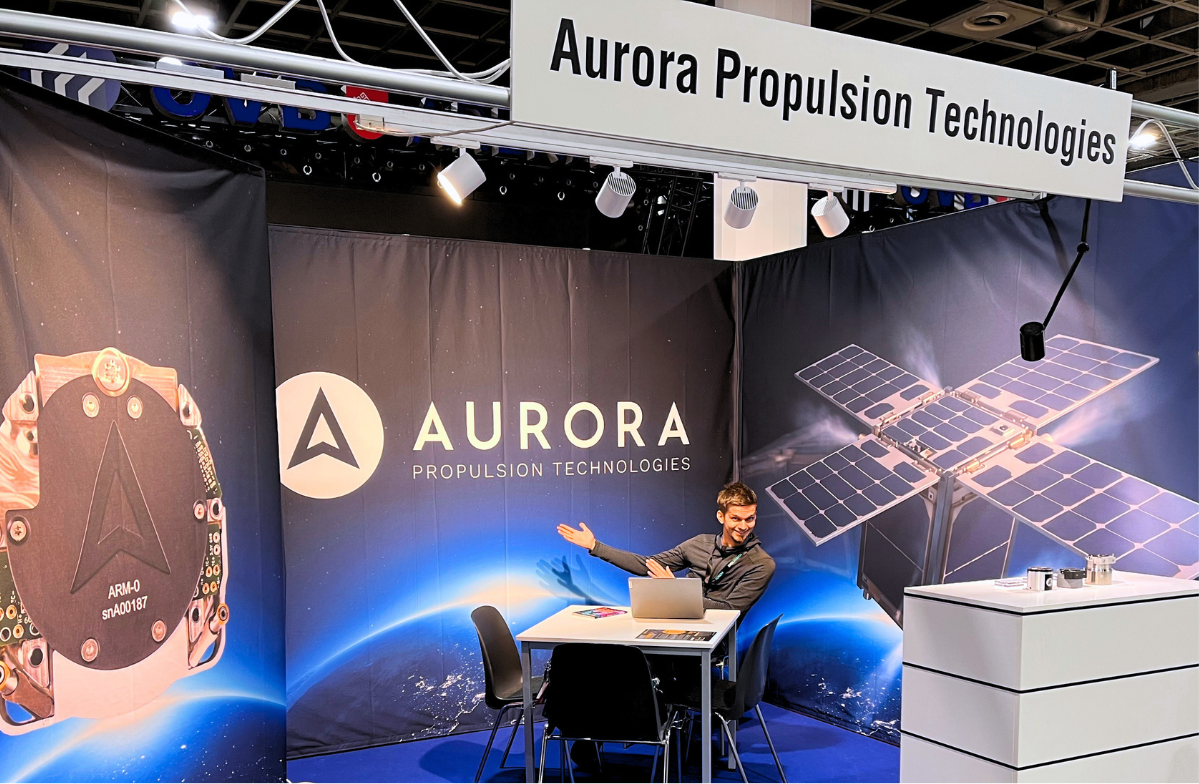

We went to Space Tech Expo Europe with two new thrusters. The conversation we came home with was about six degrees of freedom.
Space Tech Expo Europe ran in Bremen from 17 to 19 November. We were on Stand 2340 in Hall 2 for all three days, showing ARM-O LP and ARM-O HP for the first time.
We expected questions about thrust and power. We got them. But the main topic was something else.
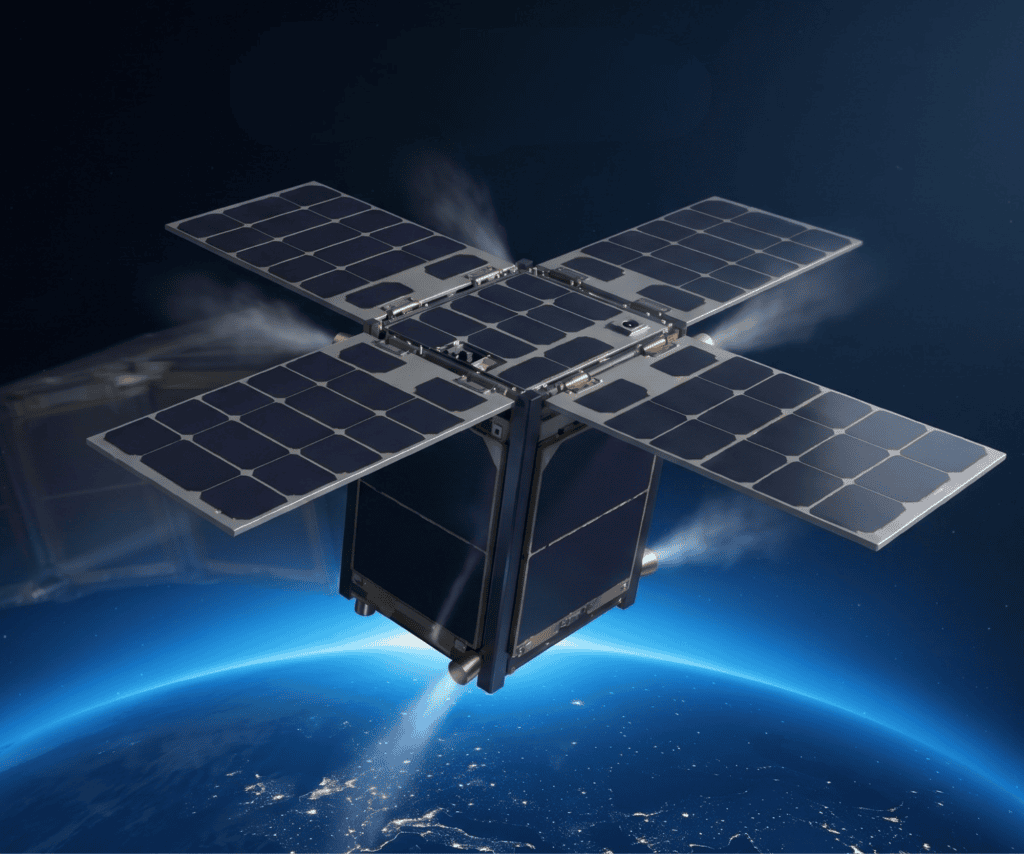
Six degrees of freedom, illustrated. Artist’s impression, not to scale.
The question has changed
Not long ago, the propulsion question was simple. Can the satellite move? Raise the orbit, hold a slot, come down on time.
In Bremen, the question was different. Can the satellite manoeuvre?
That means translating in any direction and rotating about any axis, on short notice. Three axes of translation, three of rotation. Six degrees of freedom.
Why now
In October, the tracking company LeoLabs reported that a Russian military satellite, Cosmos 2612, deliberately approached the commercial radar satellite ICEYE-X36 and stayed close to it for days. Public tracking data showed no manoeuvre by the commercial satellite.
We know only what has been published. But the effect on the industry was plain on the show floor. It came up in conversation after conversation.
Operators who had planned propulsion for station keeping are now asking a harder question. What can my satellite do when something comes close to it?
Manoeuvrability used to be a feature. It is becoming a requirement.
What it means for propulsion
More directions, not only more thrust. One strong thruster moves a satellite along one line. Six degrees of freedom need several thrusters, placed and aimed to push and to turn.
Response time matters. A manoeuvre that takes hours to start is a plan, not a reaction.
Simplicity still counts. Every extra thruster adds integration work. The propellant should not add more.
Where Aurora fits
ARM-O LP and ARM-O HP are orbit control modules. Each has two thrusters aimed toward the satellite’s centre of mass, so a burn moves the satellite without spinning it. HP delivers 20 mN for manoeuvres that have to finish quickly. LP delivers 3 mN for satellites with a limited power budget..
All of it runs on water. Non-toxic, unpressurised at launch, no fuelling operations at the launch site.
What comes next
We are following up with everyone we met. If we promised you a sizing, it is on its way.
If we missed you in Bremen, send us your mission profile and tell us how manoeuvrable your satellite has to be. Write to sales@aurorapt.fi.
Thank you to the Space Tech Expo Europe team and to everyone who stopped at Stand 2340.
About Aurora Propulsion Technologies
Aurora Propulsion Technologies was founded in Otaniemi, Espoo, in 2018 by Perttu Yli-Opas and Roope Takala. It builds water-based thrusters for small satellites and Plasma Brakes for safe deorbiting. Learn more at aurorapt.space.