


by Aziza Ibrayeva
Our second trip to India this year ended with a signed partnership and a clear demand from the market.
A month ago, Aurora was at Bengaluru Space Expo 2026, 7–9 September. It was our second visit to India this year, after India Space Congress in New Delhi in June. This time the goal was narrower. Meet the teams building India’s next satellite constellations. And find a local partner to build with.
We came home with both.
A partnership signed in Bengaluru
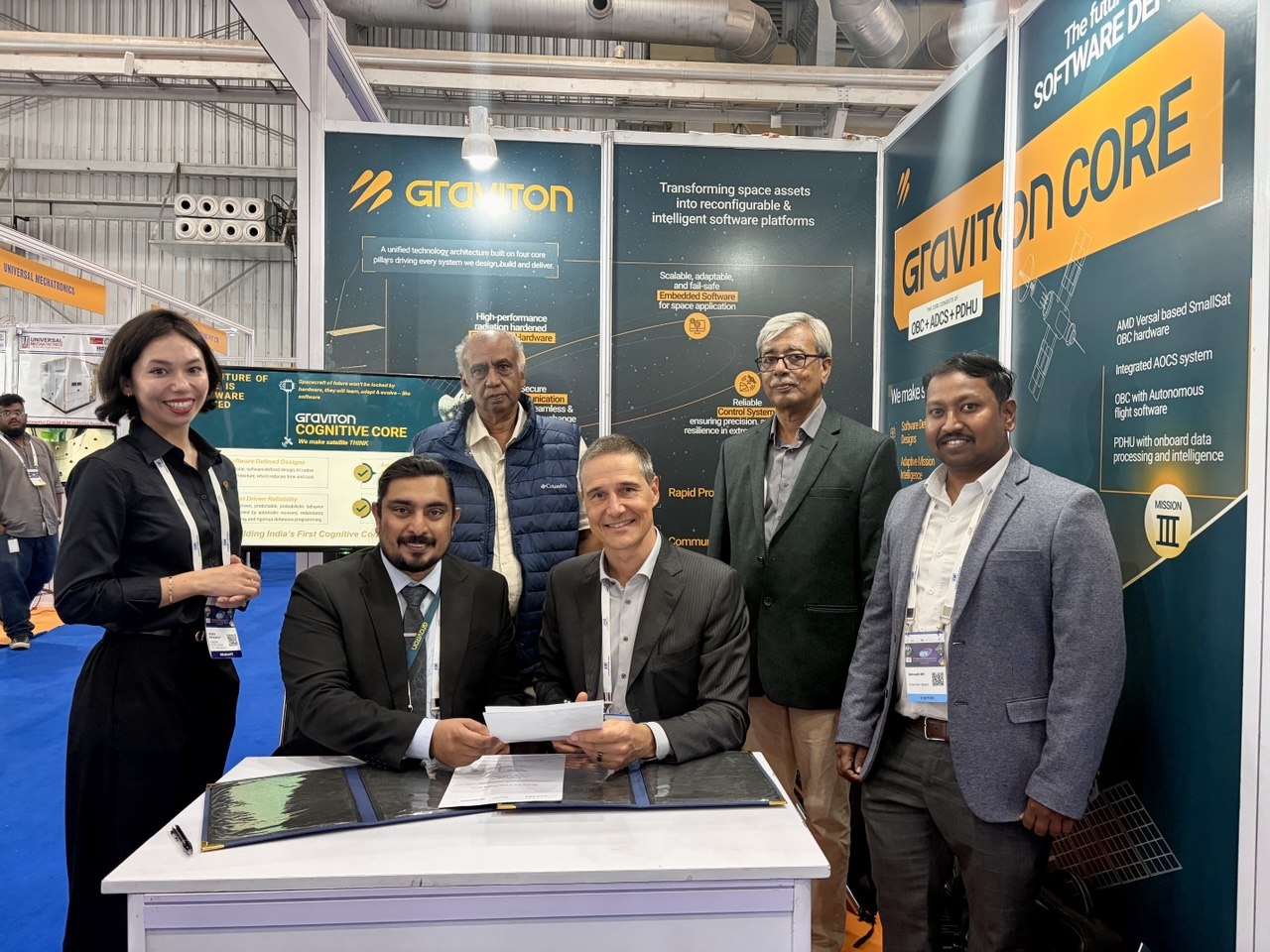
At the expo, Aurora and Graviton Space signed a memorandum of understanding. Graviton is a Bengaluru company that builds onboard avionics and autonomy software for satellites. Sumod Kurup, Graviton’s CEO, signed for Graviton.
The MoU covers OCAMS, a joint project on onboard autonomy. The idea is simple. Graviton’s software decides when a satellite needs to move. Aurora’s ARM water-based thruster makes the move. Together, they let a satellite see a risk and act on it without waiting for an operator on the ground.
This matters more every year. Low Earth orbit is getting crowded. Collision warnings arrive faster than teams can review them by hand. Autonomous avoidance turns a thruster from a component into a safety system.
It is also how we want to work in India. We want to build with Indian companies, not just sell to them. A system co-developed with an Indian partner is a stronger offer than a foreign thruster on its own.
What we heard
We spent three days at the expo and then visited teams at their offices. Three things stood out.
The volume question is here. At SmallSat in August, engineers asked us if we could make our thrusters in dozens (https://aurorapt.space/water-propulsion-smallsat-2026-trl-to-mrl/ ). In Bengaluru the same question came in a new form. Many teams are planning constellations, not single satellites. They want to know if a supplier can deliver thirty units, not three.
Small propulsion is a gap. India has strong propulsion companies, mostly focused on higher-thrust systems. Small satellites that need precise, low-thrust manoeuvres have fewer options. Think collision avoidance, station keeping and formation flying. That is where ARM fits.
Local value counts. Indian programmes increasingly ask how much of a system is developed in India. Partners like Graviton give our customers a real answer to that question.
Water, again
As in New Delhi and Salt Lake City, the propellant started conversations. Water is non-toxic. It needs no hazardous fuelling crew and no special paperwork at the launch site. For a team building its first satellites, that removes weeks of work and a lot of risk.
What comes next
Follow-ups with the teams we met are under way, and so is the next step with Graviton. Many of the people we met in Bengaluru will be in Bremen for Space Tech Expo Europe, 17–19 November. Several Indian teams also plan to visit Finland. We look forward to hosting them in Espoo.
Thank you to the Bengaluru Space Expo organisers, to Sumod and the Graviton team, and to Business Finland and the Embassy of Finland in India for their support.
Building in India and need small-satellite propulsion? Write to us at sales@aurorapt.fi.
About Aurora Propulsion Technologies
Aurora Propulsion Technologies was founded in Otaniemi, Espoo, in 2018 by Perttu Yli-Opas and Roope Takala. It builds water-based thrusters for small satellites and Plasma Brakes for safe deorbiting. Learn more at aurorapt.space.