


by Aziza Ibrayeva
Kauppalehti visits Aurora in Otaniemi: from water-powered thrusters to a space drone.
“We do rocket science.” That is how CEO Pekka Blomberg greeted Kauppalehti when the paper visited Aurora Propulsion Technologies’ lab in Otaniemi, Espoo.
The feature, photographed by Tiina Somerpuro, looks at why Finland is becoming a small superpower in space technology. Aurora sits at the centre of the story. The piece first ran on 28 August 2026 and has now been republished.
What Kauppalehti saw
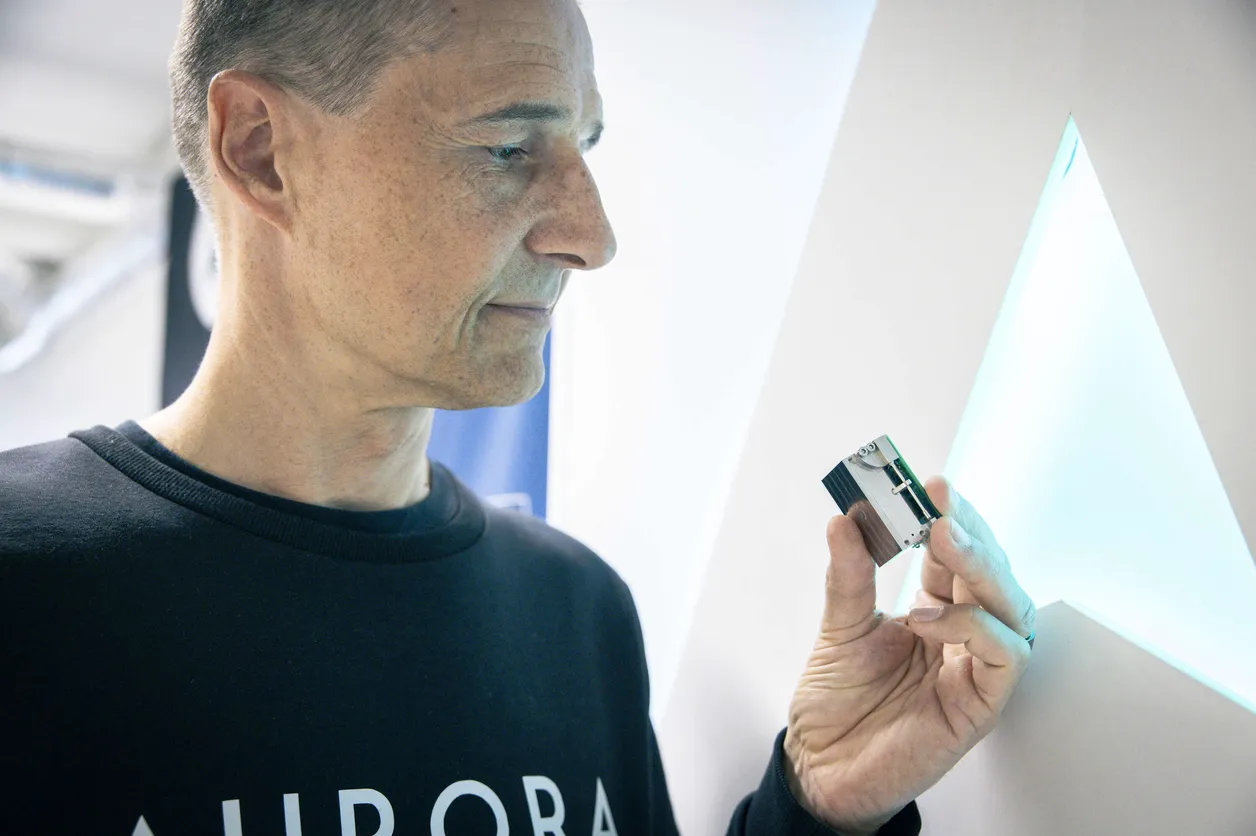
Blomberg showed the paper a thruster the size of a matchbox that runs on pure water. It vaporises water through a tiny opening, creating a high-pressure jet of steam. That is enough to move a small satellite out of a debris collision’s path.
“There are more and more satellites and more space debris. That raises the risk of collisions. If a satellite is on a collision course with debris, it has to be able to change course.”
Aurora’s thrusters are built for nanosatellites under 10 kg, a segment whose launch numbers keep rising.
“Propulsion for small satellites is still relatively rare, because there hasn’t been technology that works at small scale.”
The article also covers the Plasma Brake: a tether of aluminium wire thinner than a hair that unspools behind the satellite. An electric field on the tether slows the satellite until it falls into the atmosphere and burns up. The invention is patented by Pekka Janhunen of the Finnish Meteorological Institute, who has licensed it to Aurora and sits on its board.
Aurora thrusters and Plasma Brake fly on ESA’s WISDOM satellite, and that flight data is central to winning business.
“Our main customers are Europe’s very experienced satellite manufacturers. They are very conservative and demand enough proof, meaning measurement data from space.”
The next step: a space drone
The headline is about Aurora’s biggest plan. Blomberg describes a remotely piloted satellite with several thrusters that can be flown straight to a target. It could inspect unknown satellites, diagnose faults, counter interference or protect a critical satellite.
Aurora has applied for European Defence Fund (EDF) funding for the drone. If that comes through, it could fly in 2030.
“Once we have a space drone, it can be sold as a complete system or as a service to the armed forces of different countries.”
Part of a Finnish space story
Kauppalehti counts nearly 20 Finnish companies working directly on satellites, with combined revenue of about €350 million. Many trace their roots to Aalto University’s space technology lab, a short walk from Aurora’s office. Aurora has hired several people from the lab and uses its facilities for vacuum testing.
Lab head Professor Jaan Praks sees a lot of room to grow:
“I think it’s entirely possible we reach the billions within five years.”
Aurora has its own targets too. Revenue passed €1 million for the first time last year. Blomberg expects profitability at €2–3 million, possibly as soon as next year.
“The goal is more than €50 million in revenue within five years.”
For Aurora, the takeaway is simple. Collision avoidance and safe deorbiting are no longer a niche. They are part of how Europe protects critical infrastructure in orbit.
Thanks to Kauppalehti and photographer Tiina Somerpuro for spending the day with the Aurora team. Read the full story (in Finnish) on Kauppalehti.
About Aurora Propulsion Technologies
Aurora Propulsion Technologies was founded in Otaniemi, Espoo, in 2018 by Perttu Yli-Opas and Roope Takala. It builds water-based thrusters for small satellites and Plasma Brakes for safe deorbiting. CEO Pekka Blomberg joined two years ago from the defence sector, with a background at Airbus and Saab. Learn more at aurorapt.space.