

How Aurora Propulsion Technologies and C3S are validating the future of autonomous collision avoidance.
The industry is no longer asking if we need autonomous maneuverability. It is asking how soon it can be deployed.
Last month, the space sector gathered in Espoo for the Winter Satellite Workshop (WSW) 2026. For Aurora Propulsion Technologies, this was a home-turf event, but the focus was global: the urgent need to transition from passive, static satellites to agile, intelligent assets.
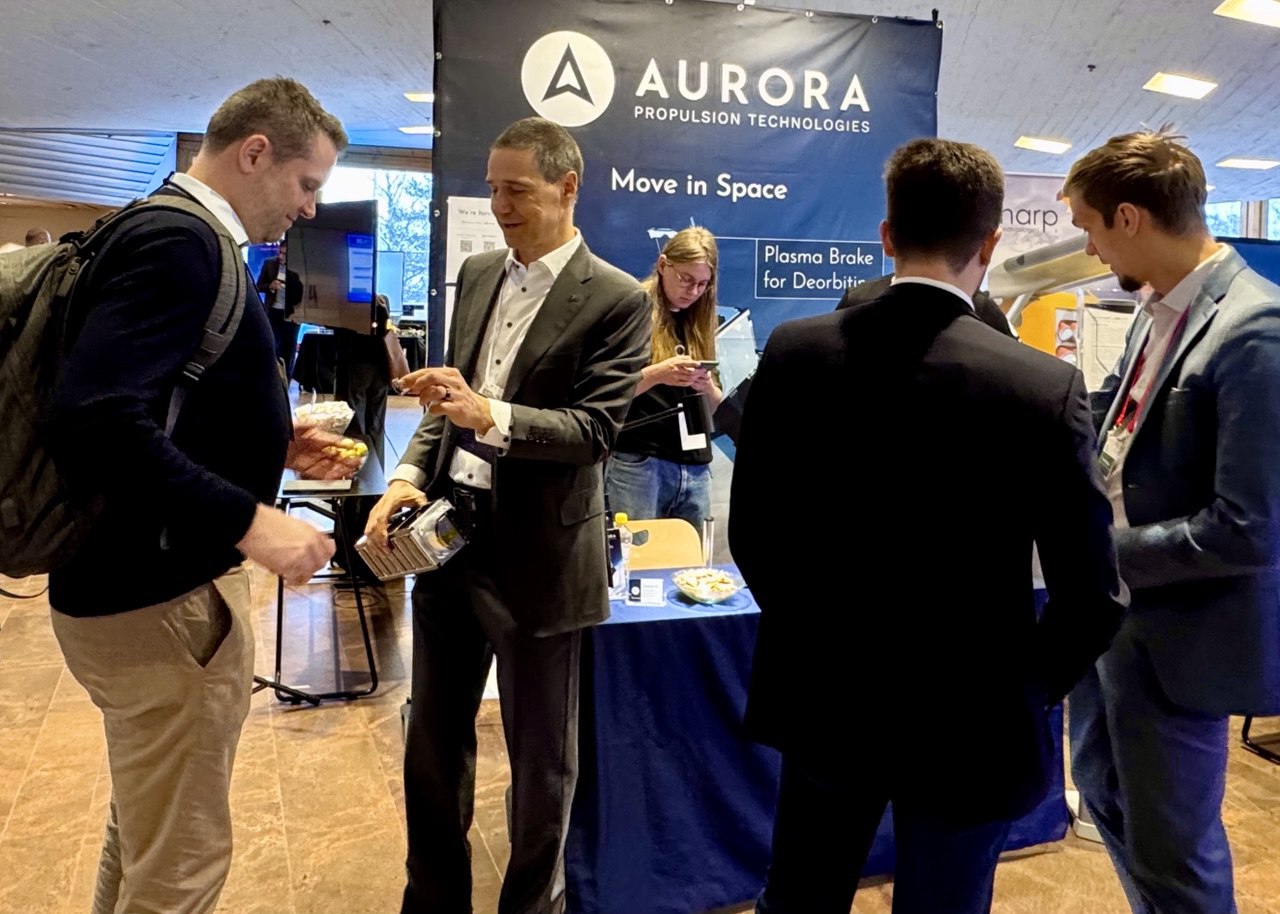
While our stand was buzzing with discussions on hardware – specifically our ARM-C and Plasma Brake systems – the highlight of the week was the technical deep dive presented by our CTO, Perttu Yli-Opas.
The WISDOM Mission: Validation in Orbit
On Tuesday, Perttu took the stage to present “First Propulsion Test Results from the WISDOM Mission.”
The WISDOM mission (Wise Integration of Satellites PNT tracking Data using OWL for collision avoidance Management), led by our partners at C3S LLC and supported by the ESA NAVISP program, is not just a standard test flight. It is a complex demonstration of the future of Space Traffic Management (STM).
As Perttu outlined to the packed room, the mission involves a unique “split” maneuver: a 6U CubeSat that separates into two distinct 3U satellites in orbit. This configuration allows the team to demonstrate:
- Autonomous Decision Making: The OWL (Orbital Whereabout Locator) system enables the satellites to track positions and manage collision avoidance proactively, without human intervention.
- Sovereign Agility: One of the CubeSats is equipped with Aurora’s ARM-C thruster systems, proving that precise, rapid maneuvering is possible even on a nano-satellite budget.
- Responsible Deorbiting: The mission validates the Aurora Plasma Brake, ensuring that once the mission ends, the assets are removed from orbit safely within two years – solving the debris problem before it starts.
Why This Matters Now
The conversations at our booth confirmed a shift in the market. With regulations like the EU Space Act looming, operators realize that manual collision avoidance is not scalable.
The WISDOM results show that the technology to automate this process exists today. By integrating propulsion directly with autonomous PNT (Positioning, Navigation, and Timing) data, we are removing the latency of ground-based decision-making.
Moving Forward
It was a pleasure to connect with our partners, the Finnish Defence Forces, and the systems engineers who stopped by to see the hardware firsthand.
If you missed Perttu’s talk or didn’t get a chance to hold the ARM-C unit at the stand, the message is simple: Static is dead. The future belongs to those who can Move in Space.
Contact our team to get updates: sales@aurorapt.fi